Is your visa history checked across borders? What a paused criminal record plan means for Vietnamese applicants
News · 2026-09-28 · 4 min read
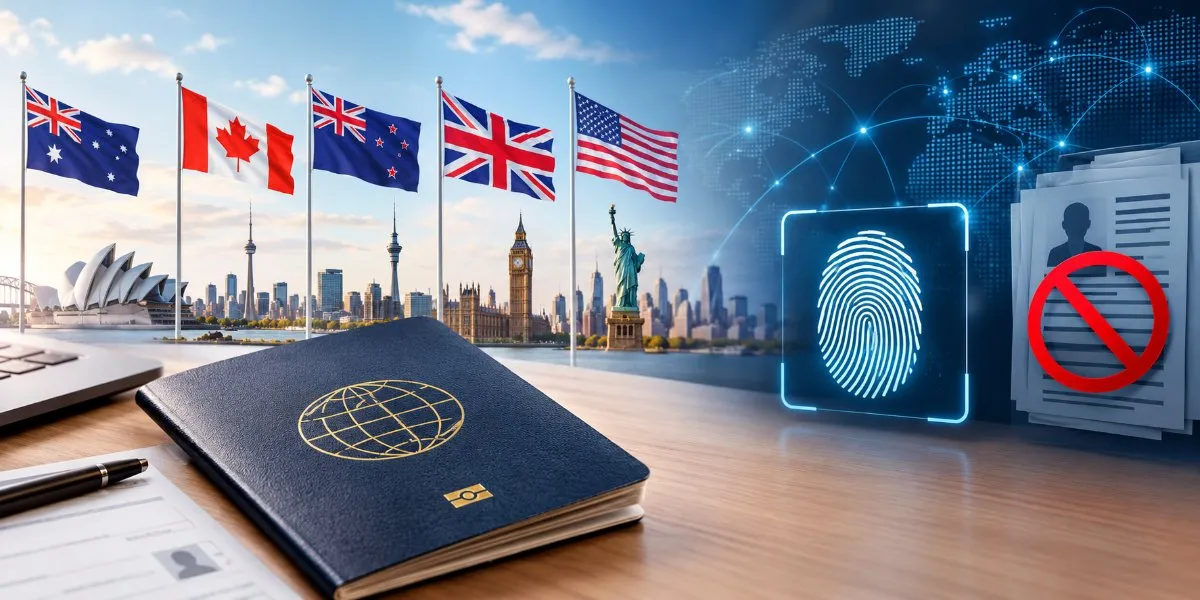
Some countries that work closely on immigration looked at sharing the criminal records of their own citizens. Now that plan is on hold. Does this mean visa checks are easier? No. This post explains the news in simple words and shows what Vietnamese applicants can do.
Which countries?
Australia, Canada, New Zealand, the United Kingdom and the United States work together. They are called the Migration 5, or M5. In April 2026, their leaders agreed to pause work on sharing information about the criminal convictions of their own citizens.
What was discussed
The older M5 agreements share identity data for migration use. They do not share criminal history. Under them, countries do not swap information about their own nationals, and New Zealand Police do not receive conviction records.
Newer talks looked at a smaller step. It would use anonymised fingerprint data to ask police or criminal record systems a question. New Zealand found that its law does not allow foreign agencies to use its police or court conviction data for immigration. During this early stage, no biometric data or conviction records were exchanged. The working group has not formally met since a virtual session in March 2025.
So the main reason for the pause is the law. Each country has its own privacy rules. A new law would be needed before the plan could return.
What is still shared
Paused does not mean no sharing. Automated exchanges of biometric and identity data continue. Biometric data means fingerprints or similar details that identify a person. New Zealand has had these agreements with most partners since the early 2010s. The UK is the exception.
In May 2025 the partners agreed on a quality-control framework. The first yearly reviews began in early 2026. New Zealand's review of the 2025 calendar year found no privacy breaches, no system access security problems and no accidental or improper disclosures.
The numbers show the system is busy.
- Australia sent New Zealand more than one million traveller data requests in the year to April 2026. They produced 676 fingerprint matches.
- New Zealand sent roughly 4,000 requests each to Canada, Australia and the UK. These gave 383, 340 and 283 positive matches.
Matches are few compared with requests. It looks like a wide screening tool that flags a small number of cases.
What Vietnamese applicants can do
- Match your details everywhere. Your name, date of birth and travel history should be the same in all forms. Check that the spelling of your name, with Vietnamese marks removed, is the same as in your passport.
- Ask for the police certificate when it is requested. For Vietnamese citizens this is usually the Judicial Record Certificate No. 2 (Phiếu lý lịch tư pháp số 2). Get certified English translations if the visa rules ask for them.
- Answer honestly. If a form asks about your criminal history, declare it. False statements can lead to refusal or bans.
- Keep your records. Save old visa applications, refusals and travel documents.
- Get advice for hard cases. If you have past convictions or refusals, talk to a qualified migration adviser or an immigration lawyer first.
Stay safe
Deal only with licensed organisations and real employers. Never pay an unlicensed broker. Be careful with anyone who asks for money upfront to secure a job or a visa, or who says they can hide your history. This does not work and can harm your case.
For official visa information, visit the Department of Home Affairs website.
In short
The plan is paused, but it may return if laws change. Identity checks continue today. Honest, matching and well-kept papers are your best protection.
#visa #identity #biometrics #police certificate #honesty #vietnamese applicants
 Harvest work in Australia: is the new visa fast lane good news for Vietnamese workers?
 Planning a New Zealand visa from Vietnam? A $90 million gap could change your costs
 Vietnamese workers: how much could your Australian visa cost after 1 July 2026?